Why AI Isn't Recommending Your Brand: 12 Research-Backed GEO Mistakes
Ranking #1 on Google no longer guarantees your brand shows up in ChatGPT, Gemini, or Perplexity answers. Here are the 12 research-backed mistakes keeping brands invisible in AI search — and what to do instead.
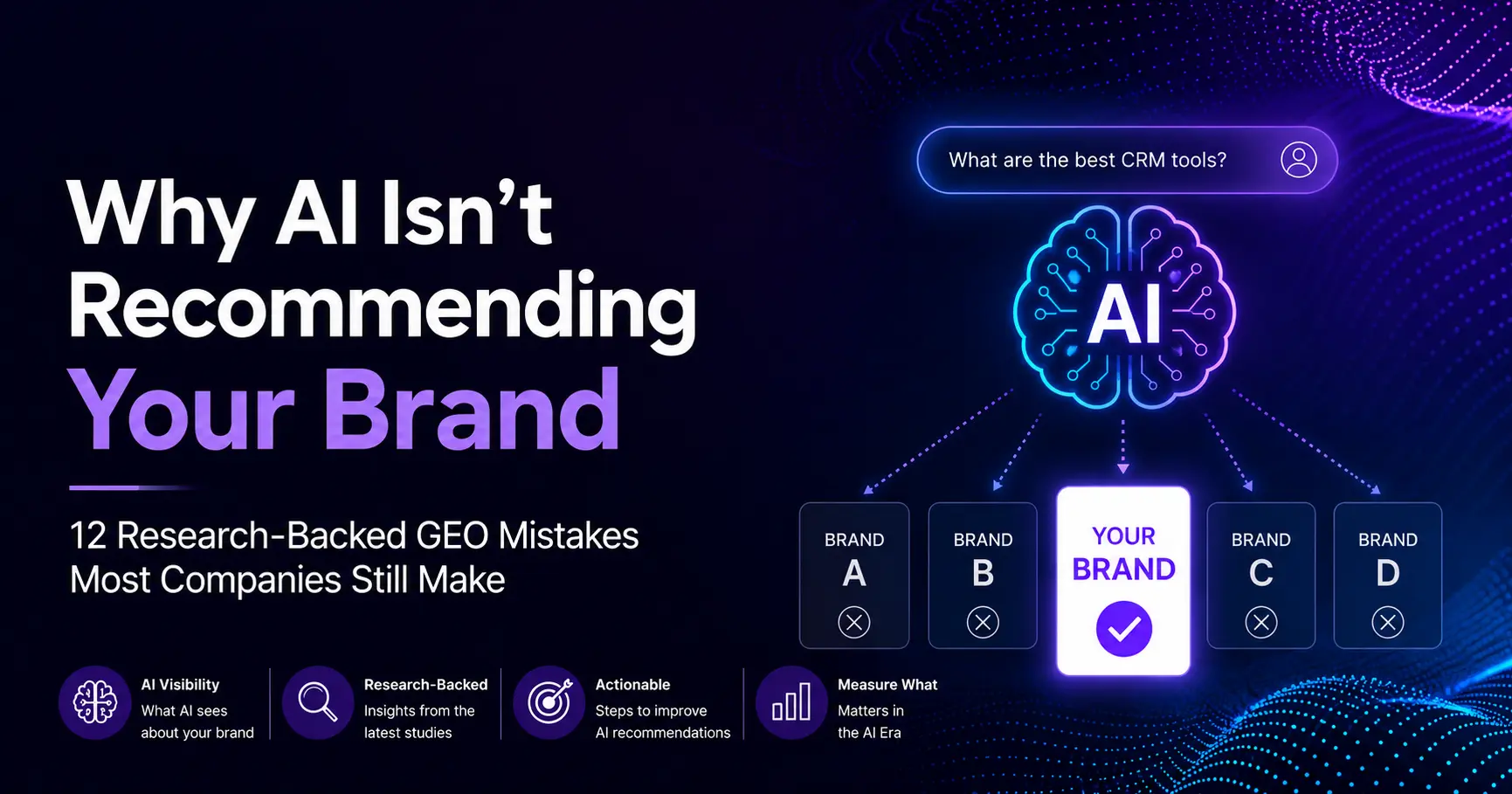
Your brand could be ranking #1 on Google and still be completely invisible to ChatGPT.
Sounds impossible? It isn't.
As consumers increasingly turn to AI platforms like ChatGPT, Gemini, Claude, and Perplexity for recommendations, traditional SEO is no longer enough. AI doesn't simply rank webpages — it synthesizes information from multiple trusted sources before deciding which brands deserve to be recommended. Yet many organizations continue approaching Generative Engine Optimization (GEO) with an SEO-first mindset, creating a gap between where they rank and whether AI actually recommends them.
1. Brands Are Still Solving an AI Problem With an SEO Mindset
For decades, marketers have measured success through keyword rankings, backlinks, organic traffic, and click-through rates. As a result, many organizations assume that updating blogs, adding FAQs, or refreshing webpages is enough to improve AI visibility. They treat GEO as a natural extension of SEO rather than recognizing it as a new discipline.
This mindset remains common. According to Semrush's 2026 AI Search Study, while 85% of marketers believe AI is transforming search, only 22% have a fully integrated AI search strategy, and just 9% actively measure AI-specific metrics. Most organizations are still relying on traditional SEO practices despite the shift toward AI-driven discovery.
The challenge is that AI systems don't simply rank webpages — they evaluate semantic relevance, entity relationships, factual consistency, and corroboration across multiple sources before recommending a brand. Ranking first on Google no longer guarantees visibility inside AI-generated answers.
2. Brands Measure the Wrong Metrics
If you ask most SEO teams how they measure success, you'll hear the same metrics — traffic, impressions, keyword rankings, and click-through rates. Unfortunately, none of these tell you whether AI is actually recommending your brand. Brands often fail to measure whether AI is citing them, recommending them, or representing them accurately.
Instead, industry reports argue that AI visibility should be measured through metrics such as AI Citation Frequency, Hit Rate, AI Share of Voice (SOV), Recommendation Frequency, ranking within AI answers, and Brand Accuracy. These metrics capture whether AI actually recommends a brand — not simply whether users clicked on a webpage. This shift matters because AI often influences purchase decisions before users ever visit a website, making click-based attribution an incomplete measure of brand visibility.
3. Brands Judge Visibility With a Single Prompt
One of the most common mistakes brands make is opening ChatGPT, asking a single question such as "What are the best CRM tools?", and assuming that one response reflects their overall AI visibility.
Academic research shows that generative AI responses are probabilistic. The same question can produce different answers depending on prompt wording, user intent, retrieval sources, platform, and model updates. This makes single-prompt testing an unreliable indicator of performance. Researchers studying AI visibility recommend evaluating brands across hundreds of prompts representing different customer journeys, buying stages, comparison queries, and conversational styles. Consistency across many prompts — not isolated appearances — is what truly reflects GEO success.
4. Brands Struggle With an Inconsistent Brand Narrative
AI learns about a brand by combining information from websites, blogs, reviews, media coverage, and customer discussions. When these sources communicate different messages across marketing, SEO, PR, customer support, and social media, AI struggles to build a consistent understanding of the brand. This doesn't just confuse customers — it also affects how AI recommends the brand.
The consequences of this mindset are already becoming measurable. Semrush found that 37% of marketers reported competitors being recommended more frequently, while 30% believed AI described their brand inaccurately and 29% said their positioning appeared generic or unclear. Inconsistent messaging is no longer just a branding issue — it directly affects AI visibility. Consistency across every customer touchpoint is now essential for AI visibility.
5. Brands Rely Too Much on Owned Content
Even brands that understand AI often make another critical assumption — they believe their own website is enough. For years, websites have been considered the centre of every SEO strategy. In GEO, however, that assumption no longer holds true. AI systems are more likely to rely on information that is consistently corroborated across multiple trusted sources rather than information published only by the brand itself.
Recent GEO research highlights that AI-generated answers rely heavily on corroborated information gathered from third-party publications, expert articles, reviews, media coverage, and authoritative websites. GEO therefore requires building an ecosystem of external authority, not just improving owned media.
6. Brands Ignore Conversation Ecosystems
Publishing content is only half the equation. Despite investing heavily in content marketing, most companies overlook where genuine customer conversations actually happen. Platforms like Reddit, Quora, community forums, podcasts, and discussion boards contain real user experiences and recommendations, making them valuable sources for AI systems.
Publishing content is only half the equation. Despite investing heavily in content marketing, most companies overlook where genuine customer conversations actually happen. Platforms like Reddit, Quora, community forums, podcasts, and discussion boards contain real user experiences and recommendations, making them valuable sources for AI systems.
7. Brands Focus on Product Features Instead of Customer Questions
Many companies create content describing product features, specifications, or company achievements. However, consumers rarely ask AI, "Tell me about your product features." Instead, they ask questions like "Which CRM is best for startups?" or "Which anti-tarnish jewellery lasts the longest?"
The original Generative Engine Optimization research demonstrated that optimization techniques focused on improving informativeness, clarity, and direct relevance to user queries consistently improved visibility in AI-generated responses. AI systems are fundamentally designed to solve user problems — not promote products. Brands that create content around real customer queries, such as comparisons, buying decisions, or problem-solving, are far more likely to be referenced in AI-generated responses.
8. Brands Fail to Build Strong Entity Associations
AI doesn't remember brands the way humans do — it remembers relationships. The brands that AI recommends most consistently are rarely those with the most webpages — they're the ones AI confidently associates with a specific topic or category. AI should immediately associate a brand with the category it wants to own. For example, if a jewellery brand wants to dominate the "anti-tarnish jewellery" category, that association must be consistently reinforced across websites, media mentions, blogs, reviews, and community discussions.
Research on semantic retrieval shows that AI systems rely heavily on entity relationships rather than isolated keywords. Without strong and consistent semantic associations, AI is more likely to recommend competitors that have established clearer category ownership. Winning GEO isn't about producing more content — it's about creating stronger semantic evidence that repeatedly connects your brand with the category you want to own.
9. Brands Don't Structure Their Content for AI
Many brands continue publishing long promotional articles that are difficult for AI systems to interpret. Dense marketing copy often lacks clear definitions, structured headings, FAQs, comparisons, statistics, and evidence that AI models can easily extract.
Research on citation failures in GEO suggests that many webpages aren't ignored because they're inaccurate — they're ignored because AI struggles to extract and confidently cite the information they contain. AI models extract information more easily from content that is well-structured, factual, and easy to cite, which aligns with Google's own guidance that content with clear authorship, topical depth, and crawlability is more likely to be surfaced in AI Overviews.
10. Brands Ignore Trust Signals
Trust has become a major factor in AI recommendations. Reviews, testimonials, expert mentions, independent citations, and customer feedback all help AI determine whether a brand is credible enough to recommend.
The role of trust isn't just theoretical. Trustpilot's analysis of 800,000 AI-generated responses across ChatGPT, Gemini, Perplexity, and Google AI Mode found a stark gap between brands with reviews and brands without them:
| Trust Signals | AI Visibility |
| Brands with no reviews | 1% |
| Brands with 80+ reviews | 75%+ |
As AI increasingly prioritizes trustworthy sources, reputation management becomes an essential component of GEO rather than a separate marketing activity. Without trust signals, AI has fewer reasons to recommend a brand confidently.
11. Brands Ignore Platform Differences
Many marketers assume that optimizing for ChatGPT automatically improves visibility on Gemini, Claude, or Perplexity. But academic research comparing ChatGPT, Gemini/Google AI, and Perplexity found significant differences in citation behavior, source diversity, and answer generation — meaning one GEO strategy cannot simply be copied across platforms.
Because each platform retrieves and weighs evidence differently, brands should monitor visibility separately rather than assuming success on one AI platform guarantees success on another. A successful GEO strategy requires monitoring platform-specific performance and adapting optimization efforts instead of assuming a one-size-fits-all approach.
12. Brands Treat GEO as a One-Time Project
Unlike traditional SEO campaigns, GEO requires continuous monitoring and refinement. AI models evolve, competitors publish new content, and online conversations constantly change. Because AI systems, user behavior, and online conversations constantly evolve, GEO should be treated as an ongoing optimization process rather than a one-time campaign.
Brands that optimize once and stop gradually lose visibility, while those that consistently improve their content ecosystem, monitor AI responses, and strengthen their digital authority remain competitive over time.
SEO helped brands get discovered. GEO helps brands get recommended.
In the age of AI, discovery no longer begins with a search result — it begins with a conversation. Brands that continue optimizing only for rankings risk becoming invisible in the very place where customers are increasingly making decisions.
- Semrush — The Operational Gap in AI Search: Why Strategy Is Falling Behind Adoption
- Semrush — Generative Engine Optimization (GEO): A Practical Guide
- Aggarwal et al. — GEO: Generative Engine Optimization (arXiv)
- Aggarwal et al. — Generative Engine Optimization: How to Dominate AI Search (arXiv)
- Wang et al. — Diagnosing and Repairing Citation Failures in Generative Engine Optimization (arXiv)
- The Impact of AI Search on the Online Content Ecosystem: Evidence from Google and Reddit (arXiv)
- From Citation Selection to Citation Absorption: Measuring Visibility in AI Search (arXiv)
- TechRadar — Trustpilot Research: Is Your Business Not Showing Up in AI Overviews?
- Business Insider — AI Search Strategies Are Being Hampered by Corporate Silos
- Evaluating AI Search Systems Across Google Search, AI Overviews and Gemini (arXiv)
See how your brand shows up in AI answers
Get a free AI visibility audit across ChatGPT, Gemini, Claude, and Perplexity.
Get Free AI Visibility Audit →More Intelligence Reports
Market Position Does Not Determine Your GEO Position
Market Position Does Not Determine Your GEO Position
Why Is Your Brand Not Visible in ChatGPT or Gemini? Here Are the 8 Main Reasons
ChatGPT alone has 9 million business users in 2026, and most buyers never click a single website link. Eight reasons brands stay invisible in ChatGPT and Gemini — from non-crawlable sites to missing analytics — and how to fix each one.