How Do I Choose a GEO or AEO Agency?
How Do I Choose a GEO or AEO Agency?

Choose a GEO or AEO agency based on how well it can measure your current AI visibility, identify the questions your customers ask, explain why competitors are recommended instead of you, and turn those findings into measurable improvements. Don't choose one because it promises to "get you into ChatGPT." Ask about methodology, platforms covered, metrics, authority strategy, reporting and case studies.
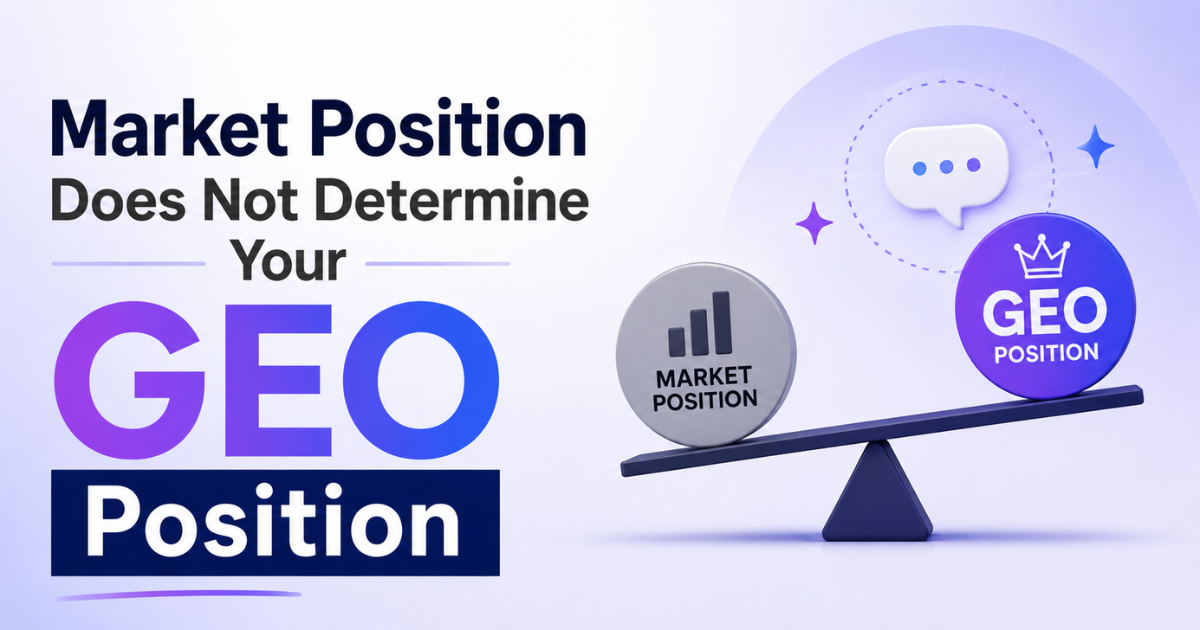
A brand can rank well on Google and still be missing from AI-generated answers. Blogchatter's analysis of Infor and Salesforce shows this: Infor recorded a 91% Hit Rate across 11 tracked keywords, while Salesforce recorded 36%, despite being the larger brand. Comparing SEO credentials alone isn't enough.
What does a GEO or AEO agency actually do?
GEO (Generative Engine Optimisation) and AEO (Answer Engine Optimisation) are often used interchangeably. Both aim to improve how a brand is discovered, understood, cited or recommended in AI-powered search and answer experiences.
A capable agency does more than write FAQ pages. Its work should include AI visibility audits, high-intent prompt research, competitor analysis, content optimisation, entity and brand authority building, citation analysis, community and earned-media strategy, technical recommendations, and ongoing monitoring.
Google's guidance is a useful sanity check here. It says there are no additional requirements or special optimisations needed to appear in AI Overviews or AI Mode, and that SEO fundamentals still matter. Its generative AI optimisation guide also addresses common "AEO/GEO" misconceptions, so a good agency should be able to explain where its methods go beyond that baseline.
1. Ask how they measure AI visibility
Traditional SEO reports cover rankings and traffic. They don't show how often AI systems mention your brand. Look for:
- Hit Rate: how often your brand appears in tracked AI responses
- Share of Voice: your share of AI mentions versus competitors
- Brand Rank: where you appear in AI recommendations
- Prompt Performance: which customer questions you win or lose
- Competitor Mentions: who appears when you don't
- Citation/Source Data: which sources AI systems rely on in your category
If an agency shows only traffic and Google rankings, ask how those connect to AI visibility. Google's own tooling is a start, since its AI features are included in overall Search Console traffic, but it doesn't cover other AI platforms.
2. Ask which AI platforms they track
Your customers may use ChatGPT, Gemini, Claude, Perplexity, Google AI experiences or others. Ask which platforms are monitored, how often, and whether the agency can show platform-level differences. Performance can vary widely between them.
3. Ask whether they track real customer questions
Customers rarely ask "What is [your brand]?" They ask things like "best brands for X," "best alternative to X," "X vs Y," or "which companies offer X in India?" A strong agency builds a prompt universe around discovery, use cases, comparisons, alternatives and purchase intent. The goal is to understand why you are or aren't visible, not just whether you are.
4. Look at what they do beyond your website
Publishing more on your own site won't automatically fix an AI visibility gap. AI systems draw on many sources, so third-party validation and consistent brand information matter. Ask how the agency builds authority outside your site: industry publications, expert content, reviews, communities, forums and creator content. It should explain why each source matters rather than promise a number of backlinks or articles.
5. Ask for a baseline before a promise
AI answers vary by platform, prompt, location and time, so be wary of anyone promising a specific ranking before auditing your brand. A better process looks like this:
Baseline → Prompt research → Competitor analysis → Strategy → Implementation → Measurement → Optimisation
Google also stresses that unique, helpful content and strong technical foundations matter most in the long run.
6. Ask for relevant case studies
Don't just ask, "Have you worked with big brands?" Ask for a before-and-after AI visibility case study similar to your business. It should show starting visibility, target prompts, competitors tracked, actions taken, time period, and changes in Hit Rate, Share of Voice and brand ranking. A documented methodology is worth far more than a testimonial.
7. Understand what they will execute
Some agencies provide an audit and recommendations for your team to implement. Others handle content, technical work, digital PR, community strategy and monitoring. Neither model is better by default. If you have a strong in-house SEO and content team, consulting may be enough. If your team is stretched, an agency that executes may deliver more value.
8. Ask about reporting and transparency
A report that says "Your AI visibility improved" isn't enough. You should see prompt-level results, competitor comparisons, platform-wise performance, Share of Voice, citation insights, content recommendations and progress against the original baseline.
Checklist before hiring
- How do you measure AI visibility?
- Which AI platforms do you track?
- How many prompts will you monitor?
- Do you track competitors as well as our brand?
- How do you improve visibility beyond website content?
- Will you execute recommendations or only provide them?
- Can you show relevant before-and-after case studies?
- What will we receive in our monthly report?
The best agency isn't the one making the biggest promise
GEO and AEO are still evolving, so methodology matters more than marketing claims. A good agency can tell you where your brand stands, which questions matter, which competitors are winning and why, what needs to change, and how success will be measured.
FAQ
What is the difference between a GEO and AEO agency?+
The terms are often used interchangeably. GEO generally targets visibility in generative AI systems, while AEO traditionally focuses on optimising for answer engines and direct answers.
Can my existing SEO agency handle GEO?+
Yes, if it has a genuine AI visibility methodology. Ask whether it tracks AI responses, prompt-level performance, competitors, citations and Share of Voice, rather than just rebranding an SEO package.
How long does GEO take to show results?+
There's no fixed timeline. A credible agency sets a baseline and reports changes over time instead of guaranteeing results in a set number of days.
Should I hire an agency or use a GEO tool myself?+
If you have a capable in-house team, a visibility tool may give you the data to manage the work internally. If you lack the expertise or time to interpret and act on it, an agency can provide strategy and execution.
See how your brand shows up in AI answers
Get a free AI visibility audit across ChatGPT, Gemini, Claude, and Perplexity.
Get Free AI Visibility Audit →More Intelligence Reports
What Are the Best Answer Engine Optimization Agencies?
What Are the Best Answer Engine Optimization Agencies?
Market Position Does Not Determine Your GEO Position
Market Position Does Not Determine Your GEO Position