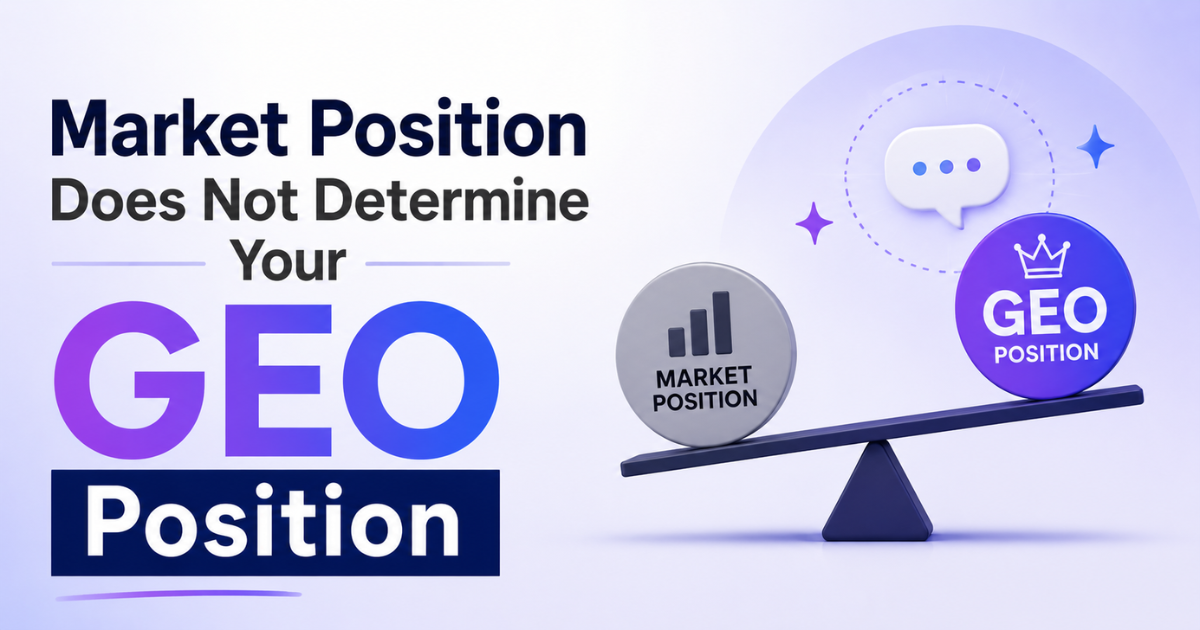
Market Position Does Not Determine Your GEO Position
Market Position Does Not Determine Your GEO Position
Infor vs Salesforce: What AI Visibility Tells Us About the New Enterprise Buying Journey
Quick Answer
Salesforce is the bigger brand by almost every conventional measure.
It reported $41.5 billion in FY2026 revenue and had 83,334 employees as of January 31, 2026. Its LinkedIn page has more than 6.6 million followers.
Infor operates at a very different scale. It has 17,000+ employees, more than 60,000 customers and about 926,000 LinkedIn followers. Public industry estimates put its revenue at around $3.4 billion in 2024.
Yet when we looked at how the two brands appear in AI-generated answers, the result was the opposite.
Infor ranked #1 in the GEO competitor landscape with a hit rate of 91. Salesforce ranked #6 with a hit rate of 36.
Infor appeared for 10 out of 11 tracked keywords. Salesforce appeared for 4 out of 11.
That is the point worth paying attention to.
Market leadership and AI visibility are not the same thing.
A company can have more revenue, more employees, a larger social following and greater brand recognition and still have a much weaker position when a buyer asks an AI platform for a recommendation.
The Infor–Salesforce gap
Our GEO scan ranked nine enterprise technology brands across 11 tracked keywords.
Infor came first.
Salesforce came sixth.
| Brand | GEO Score / Hit Rate | Keywords Won |
| Infor | 91 | 10/11 |
| SAP | 82 | 10/11 |
| Oracle | 82 | 9/11 |
| Microsoft Dynamics | 55 | 6/11 |
| NetSuite | 55 | 6/11 |
| Salesforce | 36 | 4/11 |
| Sage | 36 | 4/11 |
| IFS | 27 | 3/11 |
| Workday | 18 | 2/11 |
The difference is substantial.
Infor's hit rate is 55 percentage points higher than Salesforce's. It is also about 2.5 times Salesforce's hit rate.
This does not mean Infor is a bigger enterprise software company than Salesforce.
It means something much more specific:
When AI was asked relevant questions across the tracked keyword set, Infor was far more likely to make it into the answer.
That distinction is at the heart of GEO.
Why this matters more for enterprise brands
Enterprise software has never been an impulse purchase.
A buyer may spend months comparing ERP, CRM, HCM, supply chain or financial management platforms. There are demos, analyst reports, peer recommendations, implementation discussions, reviews and procurement processes.
AI is now becoming another part of that research process.
Gartner reported in 2025 that B2B buyers were increasingly using generative AI to gather information when considering technology purchases.
Its 2026 research found that 45% of B2B buyers had used GenAI during a recent purchase, primarily to gather information about vendors and products. Buyers used an average of seven information sources, showing that AI is becoming part of a wider research process rather than replacing every other channel.
The buying journey is also becoming more selective.
Gartner's software buyer research found that 83% of buyers change their initial vendor lineup during the purchase process, while 90% say social proof heavily influences their shortlist decisions.
This is important for enterprise brands because the battle may be happening before the vendor knows the buyer is in-market.
A buyer can ask:
Which ERP is best for a manufacturing company?
Then:
Which ERP is best for a mid-sized manufacturer?
Then:
Compare Infor CloudSuite with Salesforce.
Then:
Which platform is better for industry-specific workflows?
The answer can change at every stage.
A brand does not simply need to be known.
It needs to be relevant to the question being asked.
AI does not rank brands the way a market does
Traditional market position is built over years.
Revenue matters.
Customer base matters.
Distribution matters.
Brand awareness matters.
Employee strength matters.
Advertising matters.
Social following matters.
But an AI answer has a different job.
It is trying to answer the specific question in front of it.
That is why a brand with less overall market presence can appear ahead of a much larger competitor.
Blogchatter's GEO framework makes this distinction between SEO and GEO clear: search engines primarily return pages, while AI platforms try to construct an answer. GEO therefore depends more heavily on questions, context, structure, clear answers and topical depth.
This changes what "visibility" means.
For SEO, the question is:
Where does my page rank?
For GEO, the question becomes:
Does my brand become part of the answer?
Infor's advantage may be coming from relevance
Infor has a very clear positioning around industry-specific business software.
Its own description focuses on industry-specific cloud software, with solutions spanning manufacturing, distribution, healthcare, food and beverage, automotive, aerospace and defence, high tech and other sectors. It says more than 60,000 organisations rely on its software.
That kind of positioning matters in AI.
A generic question about enterprise software can produce one shortlist.
A question about ERP for manufacturing can produce another.
A question about supply chain management in food and beverage can produce another.
A question about industry-specific cloud ERP can produce another.
Infor has spent years building content and product narratives around these specific use cases. Independent coverage also frequently discusses Infor in the context of ERP selection and industry-specific software.
That creates useful context for AI systems.
The GEO result does not prove that Infor has a formal GEO programme. That cannot be established from the scan alone.
What it does show is that the brand's existing digital footprint is performing strongly when AI has to decide which brands are relevant.
And that is where a deliberate GEO strategy can make a difference.
The third-party effect is just as important
One of the more interesting findings from the citation review was where AI was getting its information.
The majority of citations identified in the scan were not simply Infor's own website pages.
They included third-party discussions and content across platforms such as:
- X
- Medium
- Quora
- YouTube
This matters because AI does not only need to understand what a company says about itself.
It also needs to see how other people describe, compare and recommend that company.
The same principle appears in broader buyer research.
Gartner found that social proof has a major influence on software shortlists.
G2's research has also found that enterprise buyers increasingly turn to review sites and AI search when researching software. In its 2025 research, review sites were used by 56% of enterprise buyers, while AI search was used by 55%.
This is why simply publishing more content on the brand website is not enough.
Owned content tells AI:
"This is what we say we do."
Third-party content can tell AI:
"This is how the wider internet describes us."
You need both.
We found this pattern outside the GEO scan too
There are already examples of independent content positioning Infor as a serious ERP option.
A Medium guide on ERP selection describes Infor as a major ERP provider and highlights its industry-specific CloudSuite approach.
Another Medium comparison of SAP, Infor and NetSuite describes Infor CloudSuite as a vertically focused, data-ready ERP platform.
On YouTube, independent technology consultants have published reviews of Infor CloudSuite specifically for people evaluating ERP systems. One such review describes itself as an independent assessment of Infor's strengths and weaknesses.
There are also Reddit discussions where users actively compare Infor with other ERP systems and discuss whether Infor is suitable for particular business requirements.
These are not Infor-owned properties.
That is exactly why they are valuable.
They add another layer of context around the brand.
The real GEO lesson: authority is distributed
This is where GEO differs from traditional content marketing.
A brand can have an excellent website and still have a weak AI presence.
It can publish hundreds of pages.
It can rank well for its own brand name.
It can have millions of followers.
But if relevant third-party sources do not reinforce the associations the brand wants to own, AI may still choose another company.
Blogchatter's GEO framework therefore treats owned content and third-party content as two parts of the same visibility strategy. Owned content creates brand-controlled authority, while third-party content creates credibility outside the brand's own ecosystem.
That distinction is particularly important for enterprise software.
Buyers do not want a vendor's description of itself alone.
They want comparisons.
They want opinions.
They want use cases.
They want implementation experiences.
They want recommendations.
They want proof.
And AI has access to all of these.
Why hit rate matters
The most useful number in this comparison is not simply the ranking.
It is the hit rate.
Blogchatter defines hit rate as the percentage of AI responses in which a brand is mentioned. It shows how often the brand is visible to AI users.
That gives marketers a much more practical question to answer.
Not:
"Are we visible on ChatGPT?"
But:
"How often does our brand appear when buyers ask questions that matter to us?"
In this case:
Infor: 91%
Salesforce: 36%
That means the gap is not a one-off recommendation.
Infor is appearing consistently across the tracked question set.
Salesforce is appearing much less often.
The same framework also measures share of voice, brand ranking, competitor mentions and prompt-level performance.
Together, these metrics show where a brand is winning, where it is losing and which questions need attention.
A large brand can still have a GEO problem
Salesforce's market position is not in question.
Its FY2026 revenue was $41.5 billion. It had 83,334 employees at the end of FY2026. Its LinkedIn audience is more than seven times the size of Infor's.
It also describes itself as a global leader in CRM technology and has invested heavily in AI through its Agentforce platform.
Yet those advantages did not translate into the stronger GEO position in this scan.
That should be a warning for every large enterprise brand.
Brand awareness gets you considered by people who already know you. GEO helps you get considered when the buyer asks a question.
Those are two different advantages.
GEO is not about becoming famous. It is about becoming relevant.
The Infor–Salesforce comparison makes a useful distinction between brand strength and answer presence.
Salesforce has enormous brand strength.
Infor has a much stronger answer presence in this particular GEO dataset.
Neither number makes the other irrelevant.
They measure different things.
A brand can therefore have:
- strong SEO but weak GEO
- strong social following but weak GEO
- strong revenue but weak GEO
- strong brand awareness but weak GEO
- strong owned content but weak third-party validation
That is why GEO needs to be measured independently.
What should enterprise brands do now?
1. Stop measuring only branded searches
Your brand name is the easiest question to win.
The harder questions are the ones where the buyer does not mention you.
Track questions around:
- category discovery
- use cases
- industries
- comparisons
- alternatives
- pricing
- implementation
- integrations
- pain points
- purchase intent
Blogchatter's GEO process creates a large prompt universe covering discovery, need-state, comparison and purchase-intent queries before narrowing it down for the brand audit.
2. Measure competitors, not just yourself
If Salesforce appears when Infor does not, that is useful information.
If Infor appears when Salesforce does not, that is also useful information.
The objective is to understand the questions where competitors are taking the answer.
3. Build third-party advocacy
Do not limit GEO to website optimisation.
Create useful, credible conversations around the brand on the platforms where buyers already research and validate information.
That can include:
LinkedIn. Reddit. Quora. Medium. YouTube. X.
The objective is not to flood the internet with promotional mentions.
It is to build useful third-party context that AI can discover, understand and connect with the brand.
4. Keep owned content strong
Third-party advocacy cannot compensate for poor brand information.
Your website still needs clear product information, use cases, comparisons, industry pages, FAQs and supporting evidence.
The strongest GEO strategy is therefore:
Owned content + third-party authority + continuous measurement.
This is where Blogchatter GEO comes in
Blogchatter's GEO Track is designed to measure how a brand actually appears across AI platforms rather than assuming that good SEO will automatically translate into AI visibility.
The process starts with the brand website and a structured brand worksheet covering categories, products, competitors, audiences and use cases.
The tool then creates a prompt universe and runs shortlisted prompts across platforms including ChatGPT, Gemini, Claude and Perplexity. Each prompt is tested multiple times because AI responses can vary.
The output includes:
Hit Rate
How often your brand appears.
Visibility Score
How prominent the brand is across AI platforms.
Share of Voice
How much AI visibility you own against competitors.
Brand Ranking
Where your brand appears within recommendations.
Competitor Mentions
Which competitors appear instead of you.
Prompt-level Performance
Which specific questions you win or lose.
But measurement is only one part of the equation.
The bigger opportunity is acting on what the measurement reveals.
If AI repeatedly recommends a competitor for a particular use case, that becomes a content problem.
If the brand is understood for one industry but not another, that becomes a relevance problem.
If owned content is strong but third-party citations are weak, that becomes an advocacy problem.
If the brand is mentioned but ranked below competitors, that becomes a positioning problem.
GEO makes these problems visible.
The bigger takeaway
The Infor versus Salesforce comparison is not a story about one company being better than another.
It is a story about two different kinds of market position.
Salesforce has a stronger conventional market position.
Infor has a stronger GEO position in this tracked landscape.
And that gap shows why brands should not assume that market leadership will automatically carry into AI search.
AI does not simply reproduce the market.
It interprets the question.
It weighs context.
It draws from multiple sources.
It looks for evidence.
It builds a recommendation.
And the brands that consistently appear in those answers have an advantage at a point where the buyer may already be narrowing down the shortlist.
The next competitive advantage may not belong to the brand with the biggest market share.
It may belong to the brand that AI understands, trusts and recommends when the question is asked.
That is why market position does not determine GEO position.
It is also why GEO should not be treated as an extension of SEO.
If SEO gets you found, GEO helps you get chosen.
Methodology
This analysis combines Blogchatter's GEO competitor landscape for Infor and Salesforce with publicly available company information and research on AI-assisted buying behaviour.
The GEO landscape covered 11 tracked keywords and ranked competitors by AI visibility/hit rate. Infor recorded a hit rate of 91 and appeared for 10 of 11 keywords, while Salesforce recorded a hit rate of 36 and appeared for 4 of 11.
The wider Blogchatter GEO framework evaluates prompts across AI platforms and measures hit rate, visibility score, share of voice, brand ranking, competitor mentions and prompt-level performance.
The third-party citation review is based on the citation analysis conducted as part of the GEO exercise. Platform examples include X, Medium, LinkedIn, Reddit, Quora and YouTube.
Public company data is used only to establish the difference in conventional market scale. Salesforce's FY2026 financial and employee figures come from its SEC filing, while Infor's current company information comes from Infor and its public company profiles.
This is a GEO visibility comparison, not a like-for-like market-share ranking. Salesforce and Infor have different product portfolios and market positioning. The purpose is to demonstrate how conventional brand scale and AI visibility can diverge.
The question brands should be asking
If a buyer asks AI for the best solution in your category tomorrow, will your brand be in the answer?
FAQ
What is GEO and how is it different from SEO?+
GEO (Generative Engine Optimization) focuses on improving a brand’s visibility in AI-generated answers, while SEO primarily focuses on ranking webpages in traditional search engine results. GEO helps ensure that a brand is mentioned, recommended, and accurately represented when users ask AI platforms questions.
Does a strong market position guarantee better AI visibility?+
No. A strong market position does not necessarily translate into strong AI visibility. Factors such as relevance, topical authority, content quality, third-party mentions, and how well a brand addresses specific user questions can influence whether it appears in AI-generated answers.
Why is third-party content important for GEO and AI visibility?+
Third-party content provides independent context about a brand and can reinforce how AI platforms understand and evaluate it. Reviews, comparisons, discussions, and recommendations across platforms such as LinkedIn, Reddit, YouTube, Medium, Quora, and X can contribute to a brand's overall AI visibility.
How can enterprise brands improve their visibility in AI search results?+
Enterprise brands can improve AI visibility by creating comprehensive content around use cases, industries, comparisons, alternatives, pricing, integrations, and customer pain points. They should also build credible third-party advocacy and regularly track how often they and their competitors appear in AI-generated answers.
How can brands measure their GEO performance?+
Brands can measure GEO performance using metrics such as AI hit rate, visibility score, share of voice, brand ranking, competitor mentions, and prompt-level performance. These metrics help identify which questions a brand is winning or losing and where its AI visibility can be improved.
See how your brand shows up in AI answers
Get a free AI visibility audit across ChatGPT, Gemini, Claude, and Perplexity.
Get Free AI Visibility Audit →More Intelligence Reports

Why Is Your Brand Not Visible in ChatGPT or Gemini? Here Are the 8 Main Reasons
ChatGPT alone has 9 million business users in 2026, and most buyers never click a single website link. Eight reasons brands stay invisible in ChatGPT and Gemini — from non-crawlable sites to missing analytics — and how to fix each one.
Why AI Isn't Recommending Your Brand: 12 Research-Backed GEO Mistakes
Ranking #1 on Google no longer guarantees your brand shows up in ChatGPT, Gemini, or Perplexity answers. Here are the 12 research-backed mistakes keeping brands invisible in AI search — and what to do instead.