How to Get Your Brand Recommended by AI Assistants
63.1% of US consumers use AI for product research and close to 50% trust AI-recommended brands. Six proven strategies to get your brand consistently cited by ChatGPT, Claude, Gemini, and Perplexity.
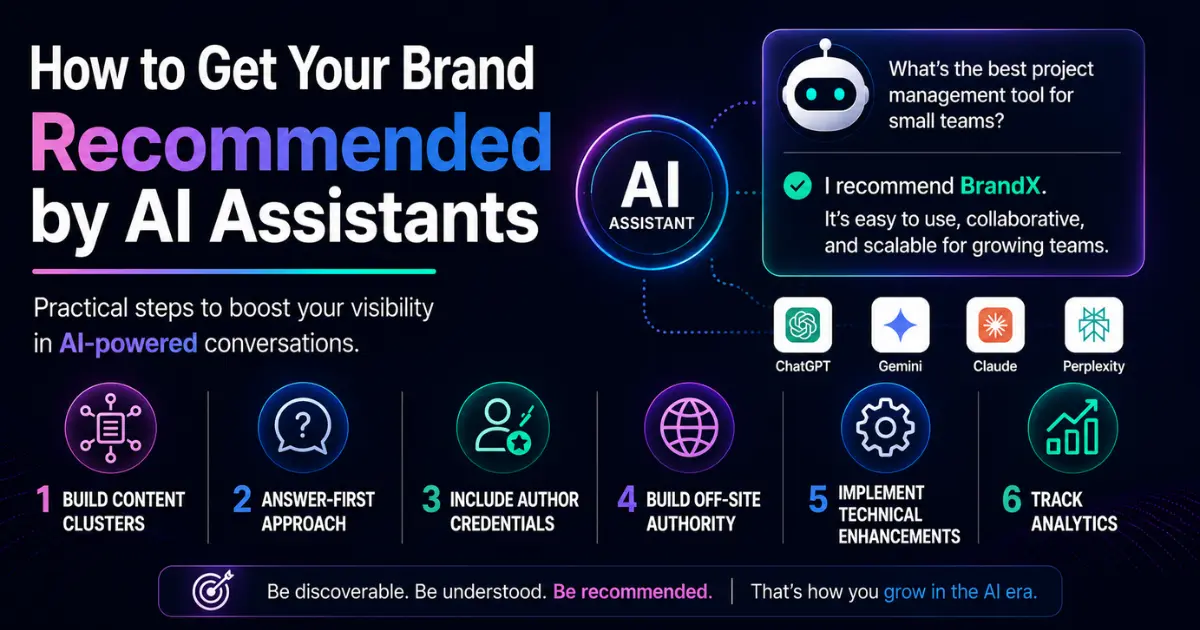
Users and customers aren't relying on Google for brand recommendations or product suggestions anymore — they're moving to AI. The Envision Horizons survey shows that 63.1% of US consumers use AI for product research, and close to 50% will trust a brand that's recommended by AI. This shows that if you want your brand to grow, getting recommended by AI assistants is non-negotiable.
However, traditional ways of featuring on Google don't work with AI Assistants, since they search for answers in a completely different way, relying more on questions rather than keywords. If you are looking for ways to get your brand recommended more by AI assistants, here are a few things you can do right away.
1. Build content clusters
AI systems don't rely on a single post or article in order to consider your brand trustworthy — no matter how good it is. AI platforms look for content that appears to be authoritative, high-value and consistent. If you want your brand to be considered high-value by AI, you need to focus on building content clusters rather than single posts about a topic.
This means starting with a pillar post that acts as an anchor for your subject, and then creating cluster posts around that. Interlinking between pillar posts and cluster posts creates repetition, which is a pattern AI recognises as knowledge. This way, AI systems start looking at you as a topical authority in your area, increasing your chances of getting featured in AI responses.
2. Focus on an answer-first approach
AI conversations with people generally consist of direct questions and responses, so if you want your brand to be recommended by AI chatbots, it's imperative that you create content that directly answers your users' questions. This works differently to traditional SEO keywords, especially short-tail ones.
Instead, make sure the answer appears in the first few lines of your content — AI models often look here and then move on if they aren't satisfied. This is also called the inverted pyramid approach, where the meat of the content appears at the top, and then you go on to elaborate on it below.
3. Include author credentials
AI systems don't just look at the content quality anymore — the author of the content is also important. The more information you display about your author, the more authoritative your content appears, which increases your chance of getting recommended by AI platforms. In fact, Presence AI found that including author credentials in content makes your brand over 40% more likely to get cited.
For every piece of content you produce, make sure you include an author bio that features the author's name, qualifications as well as a LinkedIn profile link. This acts as a trust signal for AI bots who are scouring the web for trustworthy, expert content.
4. Build off-site authority
This ties in with the fact about creating topic clusters — only you now need to think outside your website or blog. AI systems consider repetition a sign of authority and expertise, so making sure your brand and content are featured on third-party platforms is crucial, particularly since 85% of AI citations actually come from third-party platforms.
This can be done by publishing guest posts in top publications in your industry, updating your profiles on Google, Clutch and Wikipedia as well as entering your brand in directory listings of your niche. Forum discussions are another place AI platforms search, so try to keep your brand presence alive in conversations on Reddit and LinkedIn.
5. Implement technical enhancements
If you want your brand to be recommended by AI platforms, you cannot ignore the technical optimisation of your website. If your website is not accessible to AI crawlers, there is no way you will be found, no matter how good your content is or how present you are on third-party platforms.
Make sure your website has the appropriate schema markup, good mobile responsiveness, fast loading and structured data. Check your robots.txt file and ensure that your entire website is crawlable. Avoiding JavaScript is also a good idea, since it tends to limit AI visibility.
6. Track analytics
So you've made all the changes to get your brand recommended by AI assistants, but how do you know if it's working? This is where a good analytics tool like Blogchatter GEO enters the picture. A good AI analytics tool does far more than traditional SEO tools — this one measures metrics like hit rate, brand mention frequency, citation quality, sentiment analysis, Share of Voice and more.
When you have analytics information from your tool, you will know exactly if your efforts to boost visibility are working, or where you need to make changes. Blogchatter GEO also offers recommendations to optimise your content, so you don't have to waste time creating content strategies for AI platforms.
FAQ
Why is it important to get your brand recommended by AI assistants?+
Studies show that over 60% of consumers use AI chatbots for product suggestions and brand research. This means that it is crucial for brands to be visible on AI platforms when users ask queries in their niche.
What are content clusters, and why are they necessary?+
Single-piece content with traditional keyword-based SEO is no longer sufficient to get your brand recommended by AI platforms, which is why you need content clusters. These are groups of content consisting of a pillar post and associated cluster posts.
How can I get AI to consider my website as trustworthy?+
AI considers repetition to be a sign of trustworthiness, and this can be achieved by making sure your brand is present on third party platforms like industry publications, forum discussions, as well as directory listings.
What technical enhancements can help my brand get recommended by AI?+
To get your website recommended by AI platforms, make sure it is accessible to AI crawlers, has proper schema markup with structured data, and is optimized for mobile responsiveness.
How do I know that my efforts to boost AI brand visibility are working?+
The only way to know if you are on the right track with respect to AI recommendations is to track your progress through an AI analytics tool like Blogchatter GEO. This tells you where you stand as well as offering optimization suggestions for your content.
See how your brand shows up in AI answers
Get a free AI visibility audit across ChatGPT, Gemini, Claude, and Perplexity.
Get Free AI Visibility Audit →More Intelligence Reports

Market Position Does Not Determine Your GEO Position
Market Position Does Not Determine Your GEO Position
Why Is Your Brand Not Visible in ChatGPT or Gemini? Here Are the 8 Main Reasons
ChatGPT alone has 9 million business users in 2026, and most buyers never click a single website link. Eight reasons brands stay invisible in ChatGPT and Gemini — from non-crawlable sites to missing analytics — and how to fix each one.