How to Choose an AI Brand Visibility Tracking Tool
Traditional search volume has dropped 25% as users shift to AI chatbots. Seven criteria — from multi-model coverage to transparency — to evaluate before choosing your AI brand visibility platform.
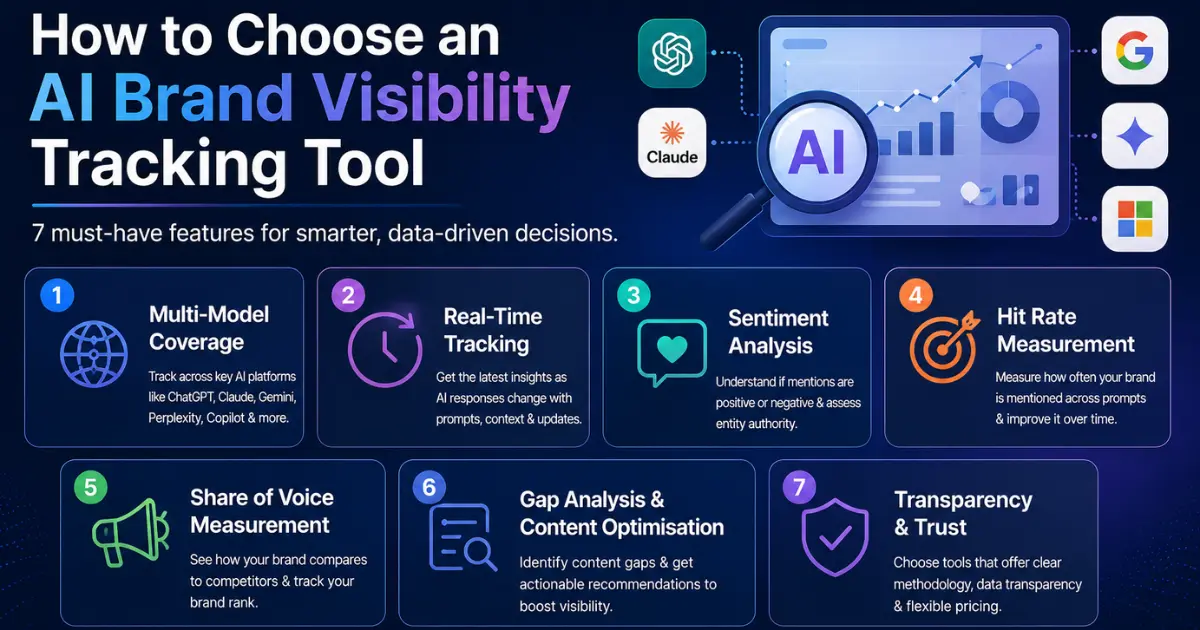
Any brand worth its salt today is no longer relying on traditional SEO analytics, since these now provide only half the picture. Gartner found that over the past three years, traditional search engine volume has come down by 25%, thanks to users shifting to AI chatbots by 25%. As a result, 88% of respondents of a McKinsey survey report that they regularly use AI in at least one business function — 10% more than last year.
This shows that if you are a business owner, it is crucial to know how your brand is visible in these AI systems, as well as how it is with respect to your competitors. The easiest way to do this is with the help of an AI brand visibility tracking tool, and there are many on the market right now. Here are a few things to consider before choosing the perfect tool for your business.
1. Multi-model coverage
The main reason people choose AI brand visibility tools is to find out how they fare on AI platforms like chatbots. That's why the first question to ask when choosing such a tool is 'how many AI platforms does it track?' At the very least, your AI brand visibility tracking tool must monitor your brand across ChatGPT, Claude, Gemini, Perplexity and Microsoft Copilot. Google AI overviews, Meta AI and Grok are added bonuses, because the more platforms you monitor, the better you can improve your brand's visibility to users and customers.
2. Real-time tracking
Unlike Google, AI queries don't give the same answer every time. Since AI responses depend upon prompt wording and conversational context, you can't be sure that your brand will be mentioned every single time. What's more, a new release of the AI platform can also change the way AI responds. That's why you need the very latest, up-to-date tracking information about your brand. If you work based on outdated data, you'll forever be playing catch-up with the AI systems.
3. Sentiment analysis
Getting information about how many times your brand is mentioned is certainly useful, but that data is incomplete without knowing whether those mentions are positive or negative. A good AI brand visibility analytics tool will offer sentiment scoring, while also providing entity authority information. This tells you whether the AI search engines consider your company or website a knowledge hub or an authority in your niche.
4. Hit rate measurement
One of the biggest differences between AI search and traditional search is that there are no fixed rankings. The same prompt can produce different answers depending on the user, conversation history, or model updates. That's why measuring your Hit Rate is critical. Hit Rate tells you the percentage of AI conversations in which your brand is mentioned for a given set of prompts. A higher Hit Rate means your brand is consistently being recommended, rather than appearing sporadically.
Tools like Blogchatter GEO don't just measure Hit Rate — they help improve it. By identifying prompts where your brand is missing, analyzing why competitors are being cited instead, and recommending authority-building content across owned, earned, and community channels, Blogchatter GEO provides a clear roadmap to increase your brand's presence across AI platforms over time.
5. Share of voice measurement
While Hit Rate tells you how consistently your brand appears, Share of Voice tells you how often your brand is mentioned compared to competitors. With 63% of companies planning to adopt AI in the next three years, it is imperative to know how your competitor businesses are performing with respect to AI brand visibility.
When consumers ask AI chatbots about companies in your category, how much of the conversation belongs to your brand versus others? This is the metric your AI visibility tool should measure. Tools like Blogchatter GEO also provide a Brand Rank, showing where you stand across AI-generated recommendations, along with deeper insights into Share of Voice by prompt category, geography, and audience segments.
6. Gap analysis and content optimisation
A good AI brand visibility tool does more than simply analyze the current scenario — it also identifies gaps in your content and provides actionable suggestions to fill them while optimising your website. For example, the Blogchatter GEO tool is an AI brand visibility analytics tool that also shows you how to boost your brand's visibility by building authority through the right mix of owned and community content. This also includes suggestions to improve structure through formatting and schema markup.
7. Transparency and trust
At the end of the day, any tool that isn't transparent and trustworthy isn't worth it in the long-term. With companies across sectors increasing their spending in AI, you have to be absolutely sure that you can trust your AI analytics tool and the data it provides. An AI analytics tool that promises complete transparency and offers multiple pricing tiers is the best choice, especially if they also offer a free trial or demo.
FAQ
How many AI platforms should an ideal AI brand visibility analytics tool be able to track?+
When choosing an AI brand visibility analytics tool, it is best to go for one with the maximum platform coverage. At the very least, choose one that covers ChatGPT, Claude, Gemini, Perplexity and Microsoft Copilot.
How can an AI tool tell me how my brand is performing with respect to my competitors?+
Many metrics can give you an idea about how your brand is performing, such as sentiment analysis and Share of Voice, which tells you how many mentions you get in your niche. Some tools, like Blogchatter GEO, also provide a Brand Rank that tells you where you stand.
Can an AI analytics tool also offer optimization suggestions?+
Yes, a good tool can often identify content gaps and also offer recommendations to fill them while also optimizing existing content. Some AI tools also tell us which prompts to target when creating further content.
How important is transparency when choosing an AI brand visibility analytics tool?+
It's always best to get yourself an AI analytics tool that offers complete transparency about how it manages your data, as well as the features offered for each pricing tier. This reduces the burden on business owners who can spend more time growing their companies.
Can I manage my brand's analytics with cached data?+
While you can, it is not recommended. AI platforms themselves are updated frequently, and they also tend to give varied responses to the same queries over time. This is why it is important to use real-time data as much as possible to analyze your brand's visibility.
See how your brand shows up in AI answers
Get a free AI visibility audit across ChatGPT, Gemini, Claude, and Perplexity.
Get Free AI Visibility Audit →More Intelligence Reports
Market Position Does Not Determine Your GEO Position
Market Position Does Not Determine Your GEO Position
Why Is Your Brand Not Visible in ChatGPT or Gemini? Here Are the 8 Main Reasons
ChatGPT alone has 9 million business users in 2026, and most buyers never click a single website link. Eight reasons brands stay invisible in ChatGPT and Gemini — from non-crawlable sites to missing analytics — and how to fix each one.