Your SEO Is Working. So Why Is AI Ignoring You?
Ranking on Google and being visible in AI answers are no longer the same thing. Here's why good SEO doesn't guarantee your brand shows up when people ask ChatGPT, Gemini, or Perplexity for recommendations.
For years, brands have treated SEO as the main answer to online visibility. If your website ranked well, if your keywords were in place, if your blogs were getting traffic, it meant people could find you. That logic still makes sense, but it is no longer the full picture.
Search behaviour has changed. People are not only typing keywords into Google anymore — they are asking full questions on AI platforms. They are using ChatGPT, Gemini, Perplexity, and AI Overviews to get quick answers, comparisons, recommendations, and summaries. In this new search journey, ranking on Google is useful, but being understood by AI is becoming just as important.
That is where many brands are getting stuck. Their SEO may be good, but their AI visibility is weak.
What does AI visibility mean?
AI visibility is about how often your brand, website, product, service, opinion, or content appears when someone asks an AI tool a relevant question.
For example, a user may not search "best parenting control device India" on Google. They may instead ask an AI platform, "What are some ways parents can make internet use safer for children at home?" or "Which Indian brands help with screen time and safe browsing for kids?"
In a normal search result, your goal is to appear as a link. In an AI answer, your goal is to be part of the answer itself — cited, mentioned, recommended, compared, or used as a source for the response. This is why good SEO does not automatically guarantee AI visibility. AI platforms do not read the internet exactly like a human scanning search results — they look for clarity, authority, context, consistency, and usefulness across different sources.
Why good SEO may not be enough
Traditional SEO often focuses on keywords, technical health, backlinks, page structure, and ranking. These are still important — Google's own guidance says that core SEO practices continue to matter for generative AI features because these AI experiences are connected to Google's Search index and quality systems. But AI visibility adds another layer.
A blog post may rank well for a keyword, but an AI tool may not pick it up if the content is too generic, too promotional, too thin, or not clearly answering real questions. A brand may have a technically sound website, but if there is not enough trustworthy content explaining what the brand does, who it helps, what problem it solves, and why it is relevant, AI has very little to work with. In simple terms: SEO helps search engines find your page. AI visibility depends on whether AI can understand, trust, and use your content.
AI platforms prefer answers, not keyword stuffing
A lot of older SEO content was written around keywords first and readers second. That approach already felt weak for humans, but it becomes even weaker in AI search. AI platforms are built around questions and intent — people ask them things like "How can a small business improve online visibility without spending heavily on ads?" or "What should parents keep in mind before choosing a school for their child?" These are not always neat keywords; they are real concerns.
So content needs to answer real questions directly. A good AI-visible blog post shouldn't only say what a product is — it should explain who it is for, what problem it solves, when it is useful, what to consider before choosing it, and how it compares with other options. This doesn't mean every article has to become a FAQ dump; it means the content should be written with enough depth and clarity for both people and AI systems to understand its purpose.
Brand mentions outside your website also matter
One reason SEO and AI visibility behave differently is that AI tools do not rely only on your website. They may draw from news articles, blogs, interviews, social posts, public profiles, reviews, listicles, community discussions, YouTube descriptions, and other sources across the web. This means your brand's digital footprint matters.
If your brand is only speaking on its own website, that may not be enough. AI systems are more likely to understand a brand when the same idea appears across credible places — a founder's LinkedIn post, a guest article, a creator collaboration, a media mention, a podcast transcript, an event recap, and a detailed blog post can all add to the larger context. This is where long-form content becomes important again — not because long content magically ranks better, but because it gives more room to explain ideas, build associations, and answer related questions. A short caption may create awareness; a detailed article can build understanding.
AI needs context around your brand
Most brands are good at saying what they sell. Fewer brands are good at explaining what they stand for in a way that can be picked up across search and AI platforms.
For example, a brand may sell a device, but the larger context may be child safety, digital wellbeing, parental control, screen time, cyber safety, education, and family routines. If the content only talks about product features, AI may not connect the brand to the larger topic. This is why content pillars matter — a brand should not only publish around its own name, but consistently create content around the problems, questions, and conversations it wants to be associated with. If you want AI platforms to understand your brand in a category, your content has to build that category connection again and again.
What brands should do differently
The answer is not to abandon SEO. The answer is to expand how we think about visibility. Brands should continue to keep their websites technically strong, readable, and search-friendly. But they also need to create content that is useful beyond ranking — writing for natural questions, building authority around core topics, adding expert-led insights, keeping information updated, and making sure the same brand story is visible across different platforms.
A strong AI visibility strategy should include detailed blogs, founder-led points of view, explainers, comparison content, product education, case studies, FAQs, testimonials, media mentions, creator-led content, and social posts that repeat the right associations without sounding repetitive. The goal is not to trick AI — the goal is to make your brand easier to understand.
The future is not SEO versus AI visibility
SEO is not dead — it is becoming part of a larger visibility system. Earlier, brands wanted to rank. Now, they also need to be referenced. Earlier, the question was "Are we on page one?" Now, the question is also "When someone asks AI about our category, are we part of the answer?"
That shift is important because users may not always click ten links to compare information — many will trust the first useful summary they get. If your brand is missing from that summary, you may be invisible even if your SEO looks healthy on paper. Good SEO can bring people to your website. Good AI visibility can put your brand into the conversation before the click even happens.
For brands, creators, and publishers, this is the next big content challenge. Write for search, yes. But also write to be understood, remembered, and recommended.
See how your brand shows up in AI answers
Get a free AI visibility audit across ChatGPT, Gemini, Claude, and Perplexity.
Get Free AI Visibility Audit →More Intelligence Reports
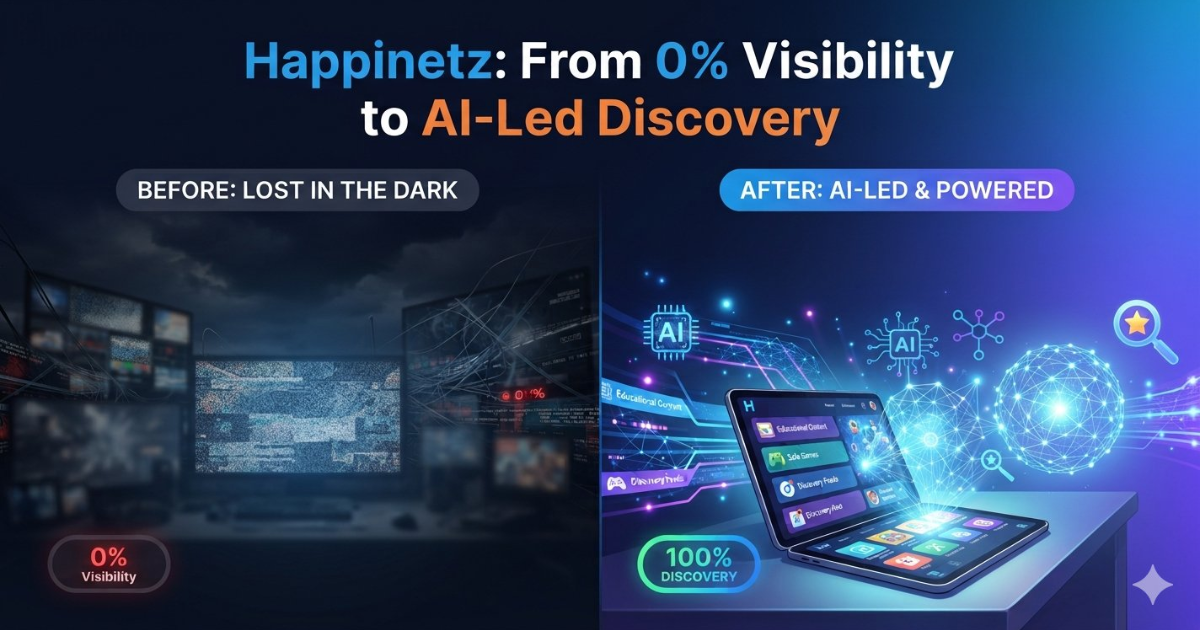
Happinetz: From 0% Visibility to AI-Led Discovery
Happinetz: From 0% Visibility to AI-Led Discovery

How to choose the best AI optimisation tool for large enterprises
How to choose the best AI optimisation tool for large enterprises