What beauty brands need to know about showing up when consumers ask AI what to buy
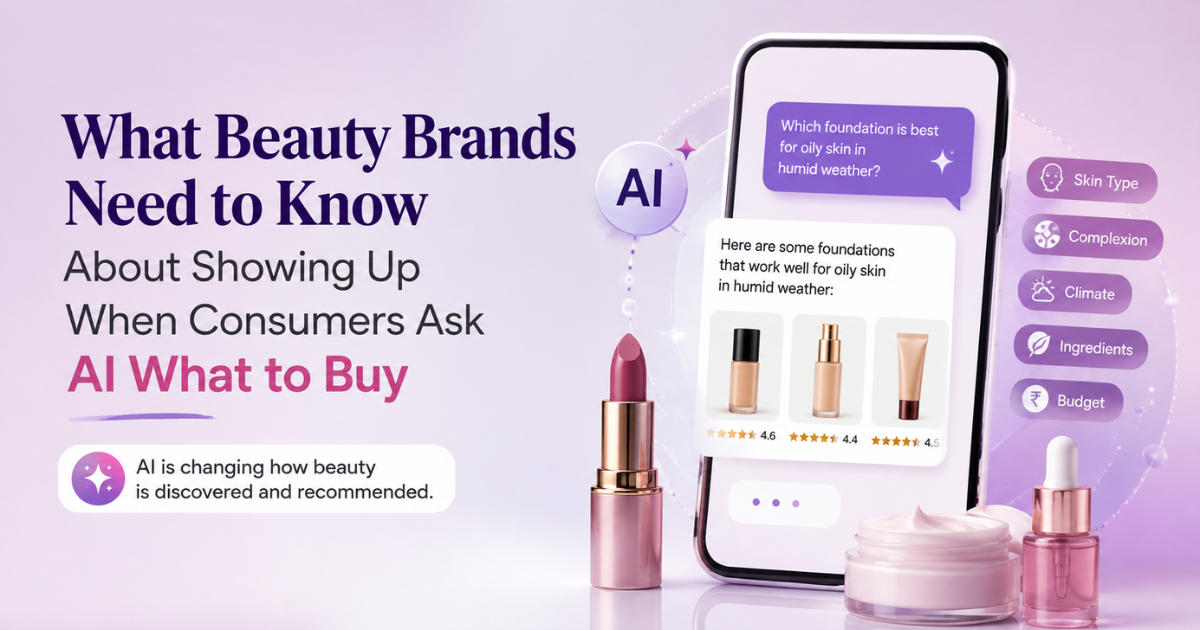
AI is changing beauty discovery from broad product searches to detailed questions about skin type, complexion, weather, budget, ingredients and suitability. For skincare and makeup brands, visibility increasingly depends on whether AI understands the specific situations in which a product or brand is relevant.
What beauty brands need to know about showing up when consumers ask AI what to buy
| Quick Answer AI is changing beauty discovery from broad product searches to detailed questions about skin type, complexion, weather, budget, ingredients and suitability. For skincare and makeup brands, visibility increasingly depends on whether AI understands the specific situations in which a product or brand is relevant. |
What is AI Discovery?
AI Discovery is the process by which consumers discover, compare or receive brand and product recommendations through conversational AI platforms instead of relying only on traditional search results.
A shopper may ask which foundation works for oily skin in humid weather, which lipstick shade suits a wheatish complexion, or which skincare product is suitable for sensitive skin. A brand can be easy to find on Google and still disappear when the same consumer adds more context.
BCG reports that 64% of Indian consumers use GenAI as part of their purchase journey, while 62% use it to choose brands and products. For beauty brands, visibility is therefore becoming less about appearing for a category and more about being understood within a need.
How are beauty searches becoming more specific?
Traditional beauty search often revolved around broad terms such as “best foundation in India” or “best sunscreen.” Conversational AI lets consumers add complexion, skin type, climate, occasion, price and personal preferences to the same question.
The dataset used for this report repeatedly surfaced questions around Indian skin tones, humid weather, long wear, cruelty-free beauty, online shade selection and product comparisons. The product category may stay the same, but the recommendation criteria change.
Why do skin tone and climate change makeup recommendations?
Makeup is highly contextual. A lipstick recommendation can change with complexion, occasion, finish and budget, while foundation can depend on undertone, skin type, coverage and climate. Questions around wheatish, dusky and darker complexions appeared repeatedly in the dataset, as did questions around heat, sweat, oily skin and smudging.
| Basic product search | Context-led beauty search |
| Best foundation | Foundation for oily skin in humid weather |
| Best kajal | Kajal that does not smudge in heat |
| Best compact | Daily-wear compact for oily skin |
| Best matte lipstick | Matte lipstick that does not dry the lips |
A brand can be visible for the broad query and absent when the consumer adds real-life context. Product pages, shade guides, reviews, creator content and editorial coverage all help establish whether those associations are clear enough for AI to use.
| Insight A beauty brand does not only need to be known for what it sells. It needs to be understood in the situations in which consumers would choose it. |
Why is skincare suitability harder to interpret?
Skincare adds ingredients, routines, concerns and compatibility to the decision. Someone looking for a moisturiser may mention oily skin, acne, sensitivity and climate, while a serum may be considered alongside other products already in the routine.
This also raises the bar for accuracy. Claims about ingredients, efficacy or skin concerns need credible evidence, and expert review, clear authorship and reliable sources become important trust signals.
How does a product feature become an AI recommendation?
Brands describe products through attributes such as long-lasting, hydrating, matte or lightweight. Consumers often express the same need differently: a lipstick that survives a wedding meal, a sunscreen that does not feel greasy during a humid commute, or an eyeliner that is easy for a beginner.
| Stage | What the consumer may ask |
| Need | Why does my makeup melt in humid weather? |
| Suitability | Which foundation works for oily Indian skin? |
| Discovery | What are the best long-wear foundations in India? |
| Comparison | Which of these foundations would suit me better? |
| Purchase | Where can I buy the right shade online? |
A brand may perform well when the shopper already knows the category but lose visibility when the conversation moves to suitability, comparison or purchase.
How do values and preferences change the shortlist?
The dataset included questions around cruelty-free, vegan and paraben-free products alongside conventional product searches. Adding one condition can create a different shortlist, just as adding a budget, skin type or complexion can.
For brands built around a particular value or attribute, that association needs to be clear beyond one product page and supported by consistent information across credible sources.
Can AI competitors be different from market competitors?
Yes. A brand may compete with one set of companies for “best makeup brands in India” and another for affordable cruelty-free makeup, beginner products or makeup for humid weather. The question determines what counts as relevant.
| Insight Your shelf competitor and your AI competitor may not always be the same brand. |
How does AI influence purchase confidence?
Beauty ecommerce asks consumers to make decisions about products they may not have tried physically. Questions around shade selection, authenticity, reviews, virtual testing, offers and delivery appeared in the dataset, showing that AI can stay involved well after discovery.
A shopper may first see a product on social media, search for it, and then ask an AI assistant whether the shade will suit them or whether the product is worth buying. Visibility at discovery does not guarantee visibility at the final decision.
Does a brand’s own website provide enough information?
Owned content establishes what the brand says, but reviews, editorial coverage, creator content, community discussions and comparisons provide external context. If a makeup brand wants to be associated with Indian skin tones, that relationship becomes stronger when independent sources and consumer experiences reinforce it.
The goal is not identical messaging everywhere. It is a clear and credible pattern of information that supports the brand’s most important associations.
How should beauty brands measure AI visibility?
A single ChatGPT search cannot show whether a brand is visible across different intents, prompt variations or platforms. A useful audit needs to look at a wider set of questions and measure more than search ranking.
| Metric | What it tells a brand |
| Hit Rate | How often the brand appears in relevant AI responses |
| Share of Voice | How much visibility the brand has versus competitors |
| Brand Ranking | Where the brand appears in recommendations |
| Competitor Mentions | Which brands appear alongside or instead of it |
| Prompt-level Performance | Which consumer questions the brand wins or loses |
What should beauty brands do next?
Start by mapping the questions around each important product rather than stopping at the category keyword. For lipstick, that may include complexion, finish, comfort, occasion and price. Sunscreen can involve skin type, texture, climate, makeup compatibility and white cast, while serum discovery can involve ingredients, routine and sensitivity.
Then check whether those answers are clear in owned content and reinforced by credible sources outside the brand’s website.
Beauty AI Visibility Checklist
☐ Does AI understand our main product categories and what they are used for?
☐ Are we visible for important skin type, skin tone, climate and occasion questions?
☐ Do our product attributes answer real consumer problems rather than sit as isolated claims?
☐ Do credible external sources reinforce the associations we want to own?
☐ Do we know which competitors appear when we do not?
☐ Are we measuring discovery, comparison and purchase questions rather than one generic prompt?
What does the next stage of beauty discovery look like?
AI lets consumers place skin type, complexion, weather, budget, ingredients and occasion inside one question. That creates another layer of competition between awareness and purchase, where a familiar brand can still be absent if AI does not connect it strongly enough with the need being described.
In search, beauty brands competed to rank for products. In AI, they are competing to become the answer to a consumer’s need.
FAQ
Why do AI platforms recommend some beauty brands more than others?+
Because visibility depends on how clearly a brand is associated with the product, category and consumer need in the question, supported by consistent information.
How does AI choose skincare recommendations?+
The answer can change with skin type, concern, ingredients, budget, routine and other context provided by the consumer.
Can smaller beauty brands compete with larger brands?+
Yes. A smaller brand can become highly relevant for a specific need even if it is not a major market competitor.
Does product information influence AI recommendations?+
Yes. Clear information helps AI understand what a product does, who it is suitable for and how it differs from alternatives.
Why does skin tone matter in AI makeup recommendations?+
Complexion and undertone can change which shades and products are relevant, especially for foundation, lipstick, blush and bronzer.
Do reviews affect AI visibility?+
Reviews and other third-party sources can add independent context to what the brand says about itself.
How can beauty brands improve AI visibility?+
Map real consumer questions, strengthen weak information areas, build credible third-party authority and monitor where competitors appear.
Is AI visibility the same as SEO ranking?+
No. SEO ranking shows where a webpage appears in search results, while AI visibility looks at whether the brand appears inside an AI-generated answer or recommendation.
Methodology
This report analysed 500+ beauty-related prompts covering product discovery, Indian skin tones, climate and wear concerns, product suitability, ethical beauty, comparisons, online shopping and purchase intent.
The prompts were assessed for brand visibility and prompt-level performance to understand how recommendation patterns change when consumers add more context. The wider GEO framework evaluates prompts across AI platforms such as ChatGPT, Gemini, Claude and Perplexity; the beauty prompt export used here does not separate results by platform, so no platform-specific conclusions have been drawn.
The first-party dataset is makeup-focused. Skincare examples are included to show how the same discovery behaviour can apply across the wider beauty category and are not presented as findings from the makeup dataset.
- Boston Consulting Group research on GenAI use in Indian consumer purchase journeys
- Internal beauty category dataset, August 2026
- GEO visibility metrics used in the analysis: Hit Rate, Share of Voice, Brand Ranking, Competitor Mentions and Prompt-level Performance
See how your brand shows up in AI answers
Get a free AI visibility audit across ChatGPT, Gemini, Claude, and Perplexity.
Get Free AI Visibility Audit →More Intelligence Reports

The Best Tool for AI Visibility - Blogchatter or Goodie?
The Best Tool for AI Visibility - Blogchatter or Goodie?

Comparison of Blogchatter GEO vs Profound GEO Analytics Tools
Comparison of Blogchatter GEO vs Profound GEO Analytics Tools