Happinetz: From 0% Visibility to AI-Led Discovery
Happinetz: From 0% Visibility to AI-Led Discovery
How Happinetz began appearing in AI answers—and why that mattered
AI platforms are increasingly becoming the first place people go when they need help making a decision.
For a category such as parental control, that journey often begins with a practical question rather than a brand search:
- “What is the best parental-control app?”
- “How can I monitor my child’s online activity?”
- “How do I keep my child safe online?”
- “Which app can help manage a child’s screen time?”
The brands that appear in these answers have an opportunity to enter consideration before a consumer has formed a preference. The brands that do not appear may be excluded from the decision before the search moves to Google, an app store, or a product website.
This report tracks Happinetz’s movement across AI-led discovery queries between June and September 2026. It shows how a focused GEO programme helped shift the brand from no measured AI visibility to appearing in relevant AI responses—and how one such AI-led discovery journey led to a purchase.
The challenge: A strong product is not automatically an AI-visible brand
Happinetz operates in a category where trust, relevance, and clarity are critical. Parents looking for parental-control solutions are not only looking for an app. They are looking for reassurance, ease of use, safety features, screen-time management, monitoring support, and a solution that works for their family.
However, AI platforms do not automatically surface the strongest or most established product in a category. They generate answers based on the information, sources, entities, relationships, and signals available to them at the time of the query.
This creates a new visibility challenge for brands:
Being available online does not necessarily mean being included in an AI answer.
When a parent asks Claude, ChatGPT, Gemini, or another AI platform for a parental-control recommendation, the relevant question is not simply whether Happinetz has a website or ranks for a keyword. The question is whether the AI system understands that Happinetz is a credible and relevant answer to that parent’s need.
That is the role of GEO: helping brands become discoverable, understandable, and recommendable within AI-generated responses.
The baseline: Happinetz was absent from tracked AI answers
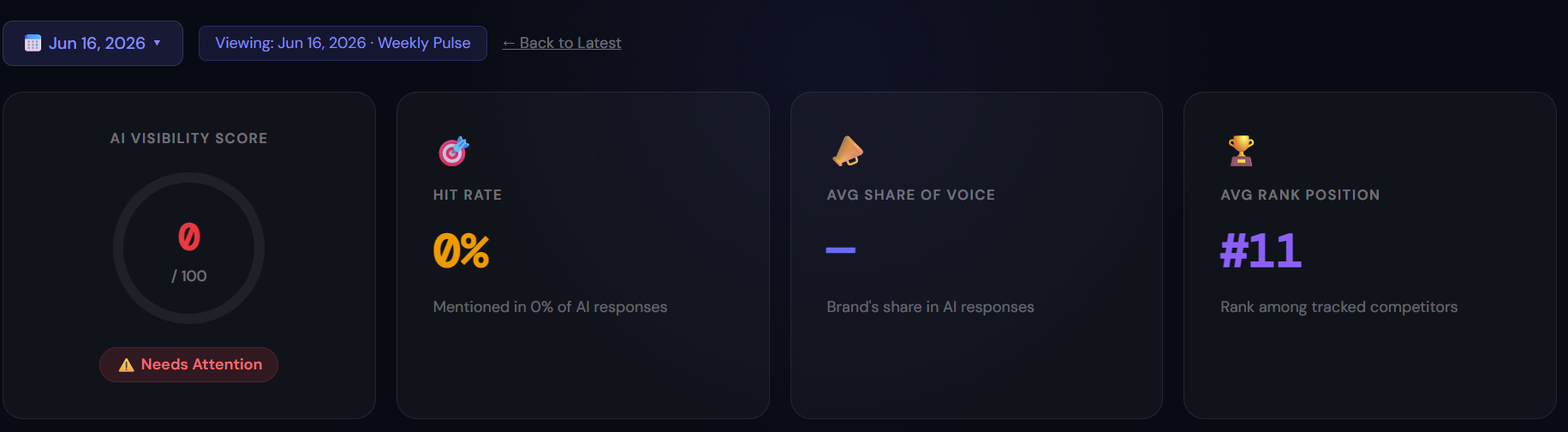
In the first GEO scan conducted on 16 June 2026, Happinetz had no measurable presence across the parental-control discovery prompts included in the audit.
June 2026 scan
| Metric | Result | What it indicated |
| AI Visibility Score | 0/100 | No measurable AI visibility across the tracked query set |
| Hit Rate | 0% | Happinetz was not mentioned in any tracked AI response |
| Average Share of Voice | — | No meaningful share of category mentions was recorded |
| Average Rank Position | #11 | Happinetz ranked outside the leading recommendation set among tracked competitors |
The scan showed a 0/100 AI Visibility Score and a 0% hit rate, meaning Happinetz did not appear in the AI responses measured through Blogchatter’s proprietary GEO framework. Its average position was #11 among the competitors tracked.
This did not mean that Happinetz lacked a relevant product or a market opportunity. It meant the brand was not yet being surfaced when consumers asked AI systems the questions that matter most in the category.
In practical terms, a parent could ask an AI platform for guidance on parental controls and receive competitor recommendations without Happinetz entering the consideration set.
The GEO opportunity
The initial scan revealed a clear opportunity: Happinetz needed to build stronger associations with the questions, needs, and signals that shape AI-generated recommendations in the parental-control category.
Rather than treating GEO as a one-time content exercise, Blogchatter approached it as an ongoing visibility programme. The objective was to improve how AI systems could identify Happinetz as relevant when people asked about parental controls, child online safety, digital wellbeing, monitoring, and screen-time management.
The work focused on four connected areas.
1. Mapping the AI discovery journey
The starting point was not the brand name. It was the parent’s need-state.
We mapped the kinds of questions consumers ask when they are looking for help with parental controls and digital safety. These queries were grouped around high-intent themes such as:
- Parental-control app recommendations
- Managing a child’s screen time
- Monitoring online activity
- Online safety for children
- Restricting inappropriate apps or content
- Managing device usage and digital habits
This matters because consumers often discover products through category questions before they search for a specific brand.
2. Diagnosing AI visibility gaps
The GEO scan established where Happinetz was missing from AI answers and where competitors were being surfaced instead.
The diagnosis looked beyond conventional search visibility. It examined whether the brand was being recognised, mentioned, positioned, and ranked in AI-generated responses against the tracked category prompts.
This helped identify the gap between what Happinetz offered and what AI systems were currently able to connect Happinetz with.
3. Building category authority
The programme focused on strengthening Happinetz’s visibility around the topics that matter to parents and AI systems alike.
This included improving the quality and relevance of the content and signals associated with Happinetz, so that the brand could be better understood in relation to parental controls, child safety, screen-time management, and responsible digital behaviour.
The goal was not just to increase content volume. It was to build useful, trustworthy, contextually relevant authority around the moments when a parent is actively seeking help.
4. Measuring, learning, and iterating
GEO cannot be measured once and assumed to be complete. AI responses change as platforms evolve, sources update, competitors improve their own presence, and consumers phrase queries differently.
Blogchatter’s proprietary GEO measurement framework made it possible to track Happinetz’s visibility across a defined set of queries and compare performance over time.
The programme used four core indicators:
| Metric | What it measures | Why it matters |
| Hit Rate | The percentage of AI responses in which Happinetz appears | Shows how often the brand is entering AI-led consideration |
| AI Visibility Score | Overall visibility across the tracked AI environment | Provides a directional view of discoverability over time |
| Share of Voice | Happinetz’s share of relevant category mentions versus competitors | Shows whether the brand is gaining space in the conversation |
| Average Rank Position | Where Happinetz appears relative to tracked competitors | Indicates how close the brand is to the most prominent recommendations |
The results: A measurable shift in AI visibility
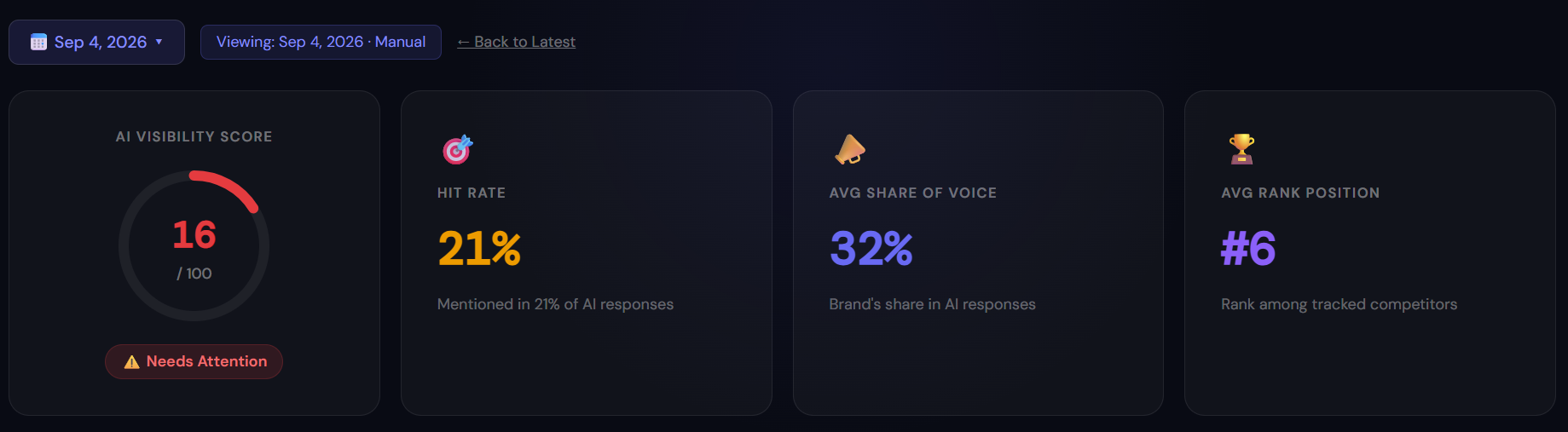
When Happinetz was re-scanned on 4 September 2026, the numbers showed a material change.
June to September 2026
| Metric | June 16, 2026 | September 4, 2026 | Change |
| AI Visibility Score | 0/100 | 16/100 | +16 points |
| Hit Rate | 0% | 21% | +21 percentage points |
| Average Share of Voice | — | 32% | A measurable share of category mentions |
| Average Rank Position | #11 | #6 | Improved by 5 positions |
By September, Happinetz had a 16/100 AI Visibility Score, appeared in 21% of the tracked AI responses, captured 32% average share of voice, and improved its average competitive rank from #11 to #6.
The most important change was not simply an increase in a dashboard score.
Happinetz moved from being absent from the AI responses measured in June to appearing in more than one in five relevant responses by September. It also gained a measurable share of voice and moved closer to the leading group of recommendations in the competitive set.
That matters because visibility within AI answers is visibility at the moment of intent.
When people ask an AI system for help, recommendations, or a solution to a problem, the brands that appear have a chance to be evaluated. Brands that do not appear do not get that opportunity.
From AI answer to purchase
The value of GEO does not stop at improved metrics.
During this period, Happinetz appeared in a Claude response when a consumer searched for a parental-control solution. The AI response introduced the consumer to Happinetz as a relevant option, and the consumer subsequently made a purchase.
This is a meaningful indication of how AI visibility can influence the customer journey:
Consumer need → AI query → Brand appears in the answer → Brand discovery → Purchase
The purchase should not be read as evidence that every AI mention will convert, or that AI visibility alone determines sales. Consumer decisions are shaped by many factors: price, product fit, reviews, website experience, product features, trust, and timing.
However, this journey demonstrates an increasingly important reality:
If a brand is not present in the AI answer, it may not even enter the consumer’s shortlist.
For Happinetz, appearing in the response created a discovery opportunity that may otherwise not have existed.
What this means for brands
AI is changing the structure of category discovery.
Traditional search remains important, but it is no longer the only point at which brands need to be visible. Consumers are increasingly asking AI systems to summarise options, compare products, recommend solutions, explain categories, and help them make decisions.
For brands, this creates three clear implications.
1. AI visibility is a consideration-stage metric
The value of AI visibility is not limited to mentions. It is about appearing at the moment a consumer is defining their need, evaluating solutions, and beginning to form a shortlist.
For Happinetz, parental-control queries are not merely informational. They are potential product-discovery moments.
2. Brands need to earn relevance, not just publish content
AI systems need enough credible, contextual information to understand when a brand is relevant. A product page alone may not be enough to establish that relationship across the range of questions consumers ask.
Effective GEO combines query intelligence, category authority, relevant content, credible signals, and continuous measurement.
3. GEO requires ongoing measurement
AI-generated outputs are not static. They vary by platform, prompt, source environment, location, language, and time.
A repeatable GEO measurement framework enables brands to see whether they are improving, where they remain absent, which competitors are gaining space, and which consumer questions offer the clearest opportunity.
The Blogchatter GEO methodology
Blogchatter’s GEO methodology is designed to help brands understand and improve how they appear in AI-led discovery journeys.
Our approach combines:
- AI visibility audits to establish the baseline and identify where the brand is absent, visible, or losing to competitors
- High-intent query mapping to understand the real questions consumers ask before choosing a product or service
- Content and authority development to strengthen the brand’s relevance across owned, expert, and community-led information ecosystems
- Competitor intelligence to track which brands are being recommended and where they are winning visibility
- Prompt-level monitoring to identify performance by consumer intent, not just by aggregate score
- Ongoing optimisation and measurement to build sustainable visibility as AI platforms and customer questions evolve
The Happinetz case demonstrates that AI visibility is not fixed. A brand can move from being absent from AI answers to becoming part of the conversation when it applies a structured, measurable GEO programme.
Key takeaway
In June 2026, Happinetz was not appearing in the tracked AI answers for relevant parental-control discovery queries.
By September, it had:
- Moved from a 0/100 to a 16/100 AI Visibility Score
- Increased its hit rate from 0% to 21%
- Achieved 32% average share of voice
- Improved its average competitive rank from #11 to #6
- Recorded an observed AI-led discovery journey from a Claude query to a Happinetz purchase
- Went from visible on 5 keywords to 32 keywords
The lesson is simple: AI visibility is not a future-facing brand metric. It is already becoming part of how consumers discover, consider, and choose products.
Results in this report reflect Blogchatter’s proprietary GEO measurement framework across a defined set of tracked prompts, competitors, and testing conditions during the stated measurement periods. The June benchmark was captured on 16 June 2026 and the follow-up scan on 4 September 2026.
AI-generated answers can vary based on the model used, query phrasing, user context, geography, language, platform updates, and changes in the wider information ecosystem. Results should therefore be understood as performance within the measured query set and conditions, not as an estimate of every possible AI interaction.
The observed Happinetz purchase reflects a specific AI-led discovery journey in which the brand appeared in a Claude response to a parental-control query and a purchase subsequently took place. It illustrates commercial potential; it does not establish that all AI visibility results in a direct or guaranteed sale.
FAQ
What is GEO?+
GEO, or Generative Engine Optimisation, is the practice of improving a brand’s ability to appear accurately and prominently in AI-generated answers on platforms such as ChatGPT, Claude, Gemini, Perplexity, and AI-powered search experiences. Unlike traditional SEO, which focuses on ranking webpages in search results, GEO focuses on helping AI systems understand when a brand is relevant to a user’s question—and include it in the answer.
Does a 21% hit rate mean Happinetz appears in 21% of all AI searches?+
No. The 21% figure applies only to the defined prompt set, platforms, competitors, and testing conditions used in Blogchatter’s GEO measurement framework. It means Happinetz appeared in 21% of the AI responses generated for the specific high-intent parental-control queries tracked in the September scan. AI outputs can vary by model, platform, prompt wording, user location, language, context, and time.
What does “AI Visibility Score” mean?+
The AI Visibility Score is Blogchatter’s proprietary indicator of how visible a brand is across the defined AI discovery environment being tracked. It brings together performance signals such as brand mentions, prominence, ranking, competitive presence, and prompt-level visibility. A higher score indicates stronger measured discoverability in the relevant AI responses. For Happinetz, the score increased from 0/100 in June to 16/100 in September, showing that the brand had moved from no measured visibility to an identifiable presence in the tracked AI-answer ecosystem.
What is hit rate?+
Hit rate measures how often a brand is mentioned in the AI responses included in the scan. For example, if a brand appears in 21 out of 100 tracked AI responses, its hit rate is 21%. For Happinetz, the hit rate increased from 0% in June to 21% in September. This means the brand began entering relevant AI-led consideration journeys after being absent from the June measurement set.
What is share of voice in AI?+
AI share of voice measures the proportion of brand mentions Happinetz receives compared with the competitors included in the tracked category responses. A 32% average share of voice means Happinetz captured a meaningful portion of the competitive conversation across the AI responses included in the September scan. It indicates that the brand was not merely appearing occasionally, but had started earning space alongside other parental-control options.
What does rank #6 mean?+
Average rank position reflects where Happinetz appeared relative to the competitors tracked in the scan. Happinetz improved from #11 in June to #6 in September. This five-position improvement indicates that the brand moved closer to the leading set of solutions being surfaced across the measured AI responses. Rank should be read as a comparative visibility signal within the defined competitor set, rather than an absolute category ranking across every AI platform or consumer query.
What did Blogchatter’s GEO programme focus on?+
The programme focused on making Happinetz more relevant and understandable within AI-led parental-control discovery journeys. The work included: Identifying the high-intent questions parents ask about parental controls, online safety, monitoring, and screen-time management Auditing Happinetz’s visibility against relevant competitors in AI-generated answers Identifying topic, content, entity, authority, and source gaps that affected AI discoverability Strengthening the brand’s relevance around key parental-control need-states Tracking visibility, share of voice, and rank over time through Blogchatter’s proprietary GEO measurement framework Using prompt-level insights to identify continuing gaps and optimisation opportunities
Did GEO directly cause Happinetz sales?+
GEO should not be presented as a guaranteed or single-source driver of sales. Purchase decisions are influenced by several factors, including product fit, pricing, features, trust, reviews, the purchase journey, and timing. However, Happinetz recorded an observed AI-led discovery journey in which a consumer searched Claude for a parental-control solution, saw Happinetz in the AI-generated response, discovered the brand through that interaction, and subsequently made a purchase. This demonstrates the commercial potential of AI visibility: when a brand is included in an AI answer, it can enter a customer’s consideration set at a high-intent moment.
Can AI visibility influence the customer journey?+
Yes. AI answers can increasingly function as a discovery and consideration layer. A typical AI-led journey may look like this: \text{Parent has a need} \rightarrow \text{Asks an AI platform} \rightarrow \text{Receives relevant options} \rightarrow \text{Discovers Happinetz} \rightarrow \text{Researches and purchases} The key point is that brands cannot be considered if they are absent from the answer. Visibility does not guarantee a purchase, but it creates the opportunity for discovery, comparison, evaluation, and conversion.
Is GEO the same as SEO?+
No. SEO helps your website rank in traditional search results; GEO helps your brand appear in AI-generated answers.
See how your brand shows up in AI answers
Get a free AI visibility audit across ChatGPT, Gemini, Claude, and Perplexity.
Get Free AI Visibility Audit →More Intelligence Reports

How to choose the best AI optimisation tool for large enterprises
How to choose the best AI optimisation tool for large enterprises

Blogchatter GEO - AI Brand Visibility Tracking Tool | Features Overview
Blogchatter GEO - AI Brand Visibility Tracking Tool | Features Overview