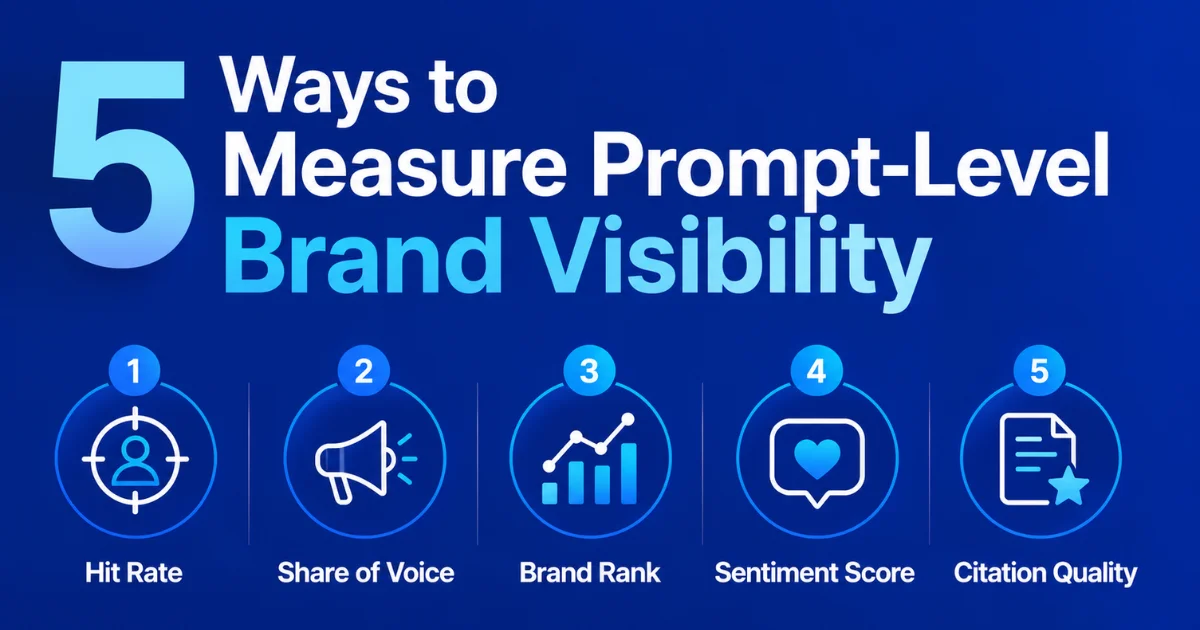
5 Ways to Measure Prompt-Level Brand Visibility
With roughly 25% of organic search traffic shifting to AI assistants, keyword rankings no longer tell the full story. Five ways to measure how often — and how prominently — your brand shows up in AI-generated answers.
With roughly 25% of organic search traffic shifting to AI assistants, keyword rankings no longer tell the full story. Five ways to measure how often — and how prominently — your brand shows up in AI-generated answers.
With roughly 25% of organic search traffic shifting to AI assistants, keyword rankings no longer tell the full story. Five ways to measure how often — and how prominently — your brand shows up in AI-generated answers.
1. Mention Frequency
The most important metric to measure prompt-level brand visibility is your mention frequency, which tells you how often your brand's name pops up on certain prompts related to your niche. The best way to find this is by making a prompt list, featuring real prompts your customers would use when looking for information related to what your company does. You then run these prompts across multiple AI platforms and note down if your brand is featured, and if so, how many times within the AI responses. You then use this as a baseline to compare your results with in the future. The best part is that most of these tasks can be automated by using a good AI analytics tool like Blogchatter GEO, which gives you real-time information on how your brand's mention frequency changes over time.
2. Brand Positioning
Being mentioned in prompts isn't enough to judge your brand's prompt visibility — you also need to measure how your brand is being positioned in the AI responses. Is the AI platform mentioning you as the first choice as a solution for the customer's problem? Or are you somewhere at the bottom of the list of options? This tells you how authoritative the AI platforms consider your brand, which directly influences your customers' buying decisions.
3. Sentiment
Prompt visibility is not just about how many times your brand is mentioned or where it is cited; the framing of those mentions also matters. For instance, it is important to know if the AI system is depicting your website as a knowledge hub, or merely as an additional resource. Is the overall sentiment around your brand mentions powerful and positive, or weak and uncertain? These are crucial metrics when it comes to influencing customer decisions, and are something brand marketers need to focus on with respect to prompt visibility.
4. Share of Voice
Any brand director worth their salt will tell you that your company's Share of Voice (SOV) is one of the key metrics you should monitor to grow your brand's AI visibility. This refers to the percentage of the number of times your brand is mentioned in AI responses. The formula for calculating SOV is: (Brand Citations / Total Category Citations) x 100. Calculating and tracking your competitors' SOV is also important, so you know exactly where you stand. Thankfully, you have tools to do this for you, like Blogchatter GEO, which doesn't just tell you your SOV, but also generates a Brand Rank that gives you a clearer idea of your position among your competitors.
5. Multi-engine Coverage
Here's another thing you need to know when measuring prompt visibility for your brand — how good is your coverage? By now, marketers have realized that the same query generates completely different responses on different AI platforms and chatbots, which means you need to monitor multiple AI systems. ChatGPT, being the one with the largest user base, is a must-have on your list of AI platforms to check, as well as Perplexity since it is citation-heavy. Other platforms to check are Gemini, Claude and Google AI Overviews, which are connected to traditional search. This can be done easily by using an AI analytics tool that supports multiple platforms, such as Blogchatter GEO.
FAQ
What does prompt-level visibility mean?+
Prompt visibility refers to how often your brand appears in the answers AI engines generate for the prompts your buyers ask. It tells you the overall framing of your brand in AI responses, as well as the sentiment.
Can keyword ranking determine prompt visibility?+
Unfortunately, no. Keyword ranking only tells you how your website ranks on SERPs, but with approximately 25% of search traffic moving to AI assistants and chatbots, you need prompt visibility to understand how your brand features on those platforms.
Why is brand positioning important?+
While being mentioned by AI chatbots in conversations is important, what's more important is how your brand is positioned in AI responses. Brand positioning tells you if your brand is treated as the prime solution for the user's problem, or if it's clumped together with inferior alternatives.
How can I calculate my brand's Share of Voice?+
Share of Voice is the percentage of the number of times your brand is mentioned in AI responses. It can be calculated with this formula: (Brand Citations / Total Category Citations) x 100. So if your brand is mentioned 25 times among 100 responses, your SOV is 25.
Are there any tools that can help measure prompt visibility?+
Yes, a good AI analytics tool like Blogchatter GEO can measure the various metrics associated with prompt visibility, such as citation frequency, hit rate, Share of Voice and brand rank.
See how your brand shows up in AI answers
Get a free AI visibility audit across ChatGPT, Gemini, Claude, and Perplexity.
Get Free AI Visibility Audit →More Intelligence Reports
Happinetz: From 0% Visibility to AI-Led Discovery
Happinetz: From 0% Visibility to AI-Led Discovery

How to choose the best AI optimisation tool for large enterprises
How to choose the best AI optimisation tool for large enterprises